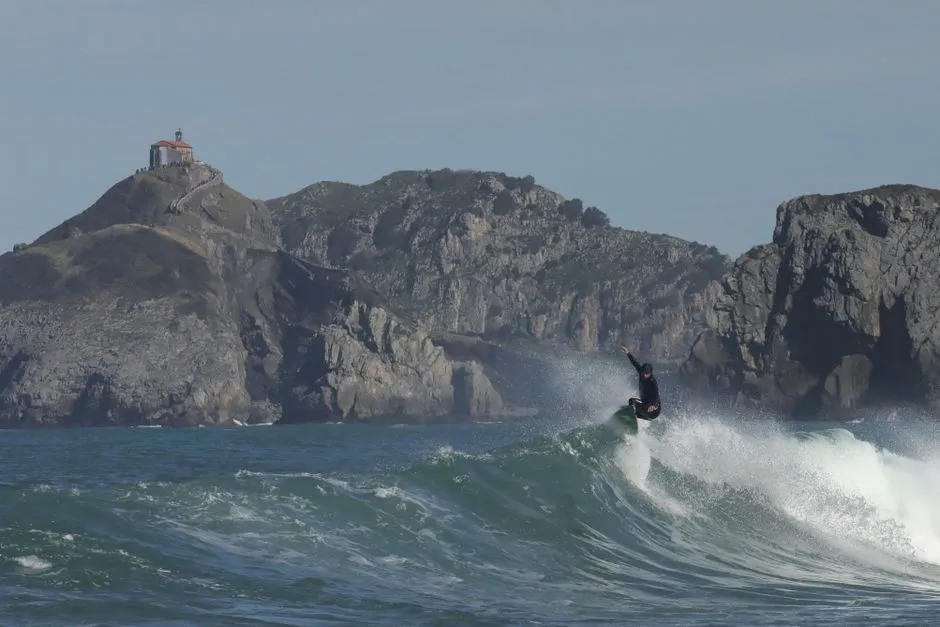
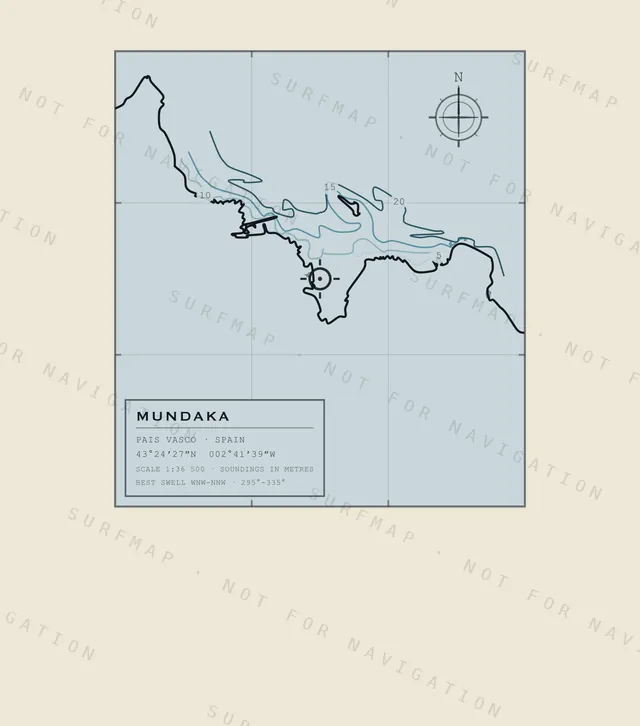
Mundaka is a fishing village on the west bank of the Urdaibai estuary, 45 minutes from Bilbao, with a small harbour, a church on the point and, on the sandbar just below the church, one of the best left-hand waves in the world. The Oka river and the tides build the bar at the mouth of the estuary, and when a solid, long-period northwest groundswell meets it on the right tide, the wave takes off beside the harbour wall and peels 200 to 400 meters down the bar toward the beach inside: fast, hollow, barrel after barrel, with a shoulder that lets a good surfer breathe between sections.
The honest part comes next. Mundaka needs a lot to happen at once, and most of the year it does not: the wave breaks properly maybe a few dozen days a season, almost all of them between October and February, and sleeps the rest of the time. When it does wake up, the whole of northern Spain and a good part of Europe knows within hours, the locals are very good, and the harbour wall fills with people who came to watch. Plan a trip around a chart, not a calendar, and treat a real Mundaka day as the gift it is.
Advanced
Wave
Left-hand rivermouth wave over a sandbar
Best swell
Solid long-period NW groundswell, head-high to well overhead; most locals say 14 seconds and up
Best wind
S to SE offshore
Best tide
Low to mid on the push. High tide fattens it, the dropping tide pours the estuary out through the lineup
Season
October to February
Level
Advanced to expert when it is on
How the wave breaks
The wave starts where the harbour wall ends, just off the rocks below the church of Santa María. A set stands up on the outer edge of the bar, the takeoff is steep and quick, and the first section throws almost at once: this is the part of the wave that decides your day, because the sand is shallow here and the barrel is the whole point. Make the drop, get under the lip, and the wave runs down the bar in front of the village with the estuary current feeding it from the side.
What sets Mundaka apart from most rivermouths is how long it keeps its shape. On a solid long-period northwest swell at the right stage of a rising tide, a single wave can run 200 to 400 meters, section after section, the tube closing and opening again two or three times before the shoulder finally softens toward the beach inside. There is room to breathe between sections, which is why good surfers come out of it grinning rather than wrecked. Then the tide fills in, the wave fattens, and an hour later the same lineup looks like an ordinary rivermouth.
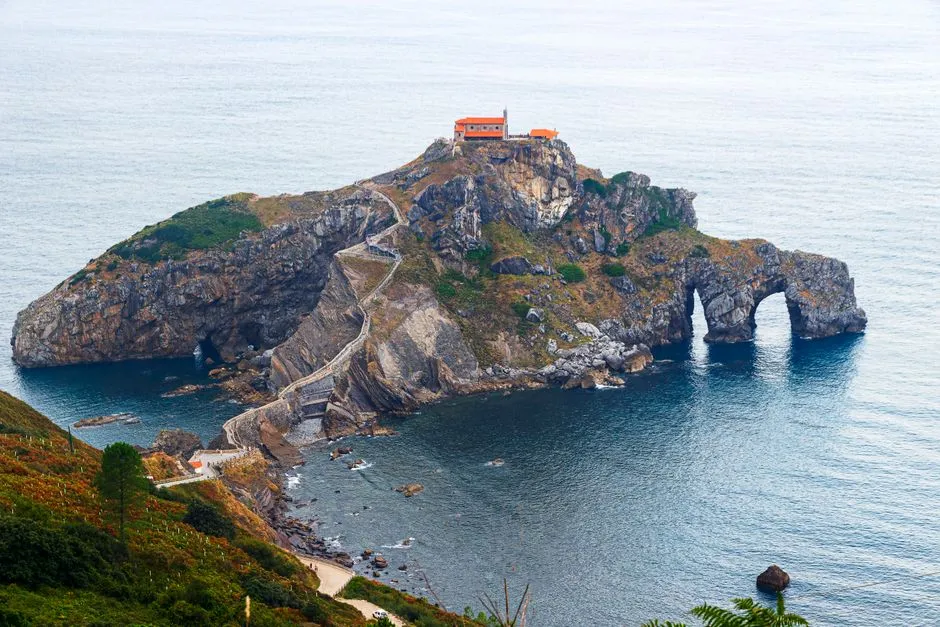
The islet of San Juan de Gaztelugatxe, its chapel and stone stairway, on the Bizkaia coast west of Bermeo
When it works
Mundaka asks for three things at once and gives nothing until it gets all of them. First a groundswell from the northwest, solid and long: roughly 6 feet at 14 seconds and up is where most locals start paying attention, and a short-period windswell of the same size barely registers on the bar. Second a wind from the south to southeast, which blows down the estuary and holds the lip up; anything from the west or north turns the wave to mush. Third the lower half of a rising tide. At high tide the wave fattens and shuts down, and as the tide drops the estuary empties through the lineup, the current turns the paddle brutal and the takeoff drifts out of position.
That combination shows up mostly between October and February, when the Atlantic lows track close enough to send long-period swell into the Bay of Biscay, and even then only on a few dozen days a season, sometimes far fewer. In summer the bar sleeps under small, weak swell and the village belongs to the beach at Laida across the water. Watch the charts, not the calendar: a real Mundaka day is a week of anticipation and a few hours of surfing, which is why the whole coast treats it as an event.
The lineup and the take-off
You get in from the harbour steps or from the rocks below the church, and you time it between sets: the wall throws a lot of water back, and the rocks at the takeoff are the one thing here that is not sand. Outside, the pack sits tight on the peak, the deepest surfers closest to the wall, and on a proper day that pack holds some of the best surfers in Spain plus everyone who drove through the night from France and Portugal. Paddling straight to the top of it is a mistake you make once.
The honest play is the same as at every great wave: sit down the line from the peak and take what the pack lets through, the second wave of the set, the one that swings wide, the section someone falls on. After a long one you have a choice. Paddle back up the bar against the estuary current, which on the dropping tide is serious work, or walk back around through the village and jump in again from the harbour. Most people who surf here often take the walk, catch their breath, and watch a set from the church on the way.
Getting there and where to stay
Mundaka is about 45 minutes from Bilbao by car, on the road to Bermeo through Gernika, and it is one of the few world-class waves in Europe you can reach by train: the Euskotren line from Bilbao to Bermeo stops in the village, a short walk from the harbour. Bermeo is five minutes north, Gernika fifteen minutes up the river, and Laida beach faces you across the estuary, a short boat ride in season or a drive around through Gernika the rest of the year.
Stay in the village if you can, or in Bermeo and Gernika when Mundaka is full, which on a good forecast it will be. The village is small: a harbour, a few streets, the church on the point and a handful of bars where the day is discussed in Basque and Spanish. Whatever the swell does, the terrace by the church and the harbour wall are the best surf-watching spots in the Basque Country, and a set seen from there on a proper day is worth the trip on its own.
Hazards
Rocks along the harbour wall and under the church right at the takeoff: get in between sets and know where the wall is before you commit to a late one
The estuary current on the dropping tide drags the whole lineup out to sea and turns the paddle back into hard work; walking around through the village is often the smarter way back
A heavy, hollow wave over thin sand at low tide: the barrel is shallow, and a wipeout on the inside puts you on the bottom
One of the most competitive lineups in Europe when it is on: sit down the line, wait your turn, and never drop in on someone at the peak
Cold water through the season, 12 to 14°C in the depths of winter: a 4/3 with a hood on the cold days, and something warm waiting in the car
An honest guide to surfing the Spanish Basque Country: Mundaka's legendary left, Zurriola's city peaks and the beaches between Bilbao and San Sebastián, month by month.
Less than its fame suggests. It needs a solid long-period northwest swell, a south wind and the lower half of a rising tide together, and that combination lands on maybe a few dozen days a season, almost all between October and February; some winters far fewer. Between those days the bar sits under small, weak surf or nothing. Do not book a week and hope: watch the charts and drive when they line up.
What swell and tide does Mundaka need?
A long-period groundswell from the northwest, roughly 6 feet at 14 seconds and up by most locals' reckoning; short-period windswell of the same size barely shows on the bar. Wind from the south to southeast, blowing down the estuary. Tide: the lower half on the push, low to mid and rising. At high tide the wave fattens and shuts down, and on the drop the estuary pours out through the lineup and the current gets brutal.
Can an intermediate surfer surf Mundaka?
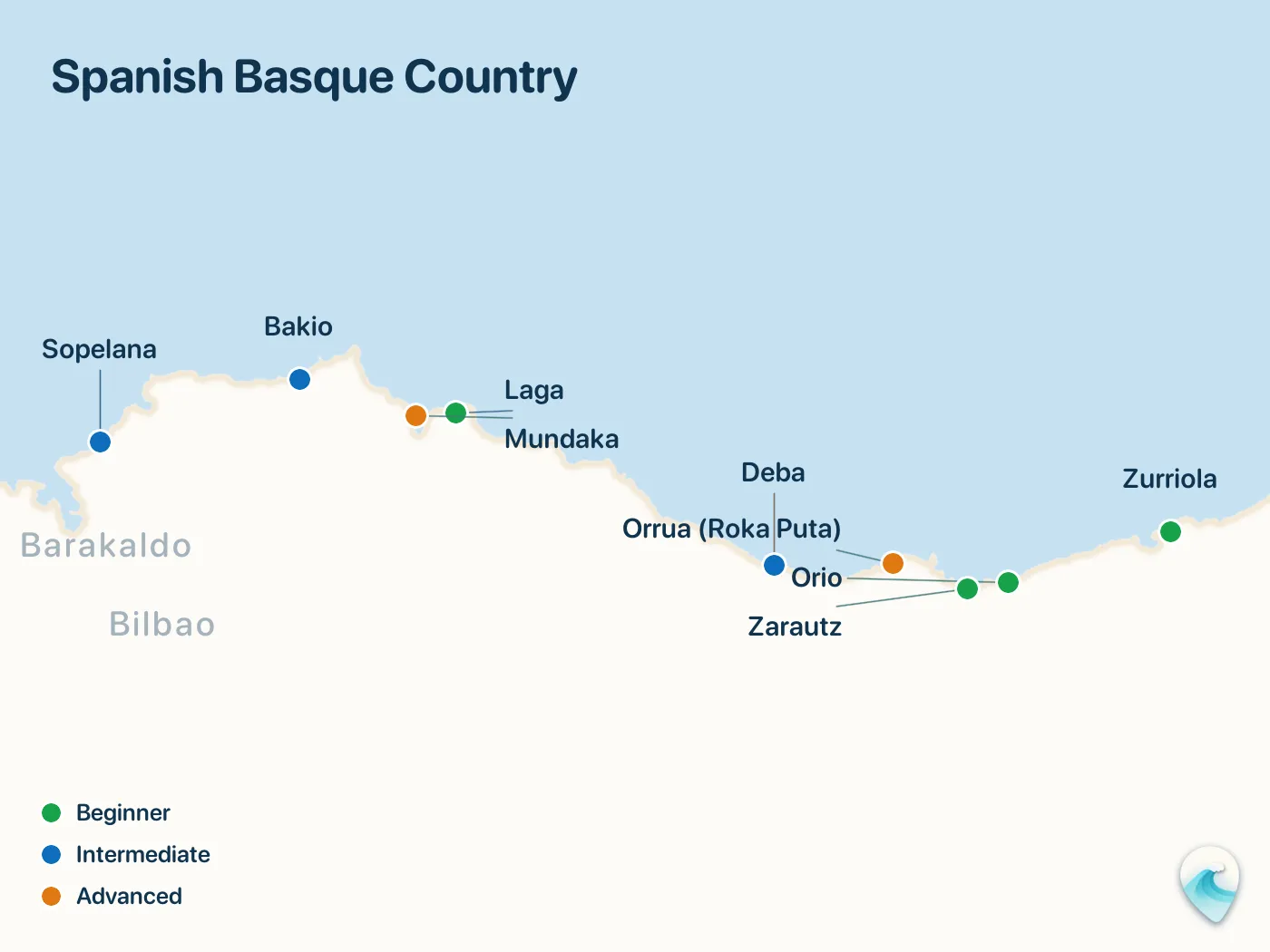
On a real Mundaka day, no, and it is worth saying: a fast takeoff next to rocks, a hollow wave over thin sand, a current that empties the estuary through the lineup and a pack of very good surfers leave no room to learn. On a small, clean day at mid tide an experienced intermediate can sit wide, catch a few shoulders and watch how the locals read it. Otherwise Laida, Bakio and Sopelana are the honest alternatives.