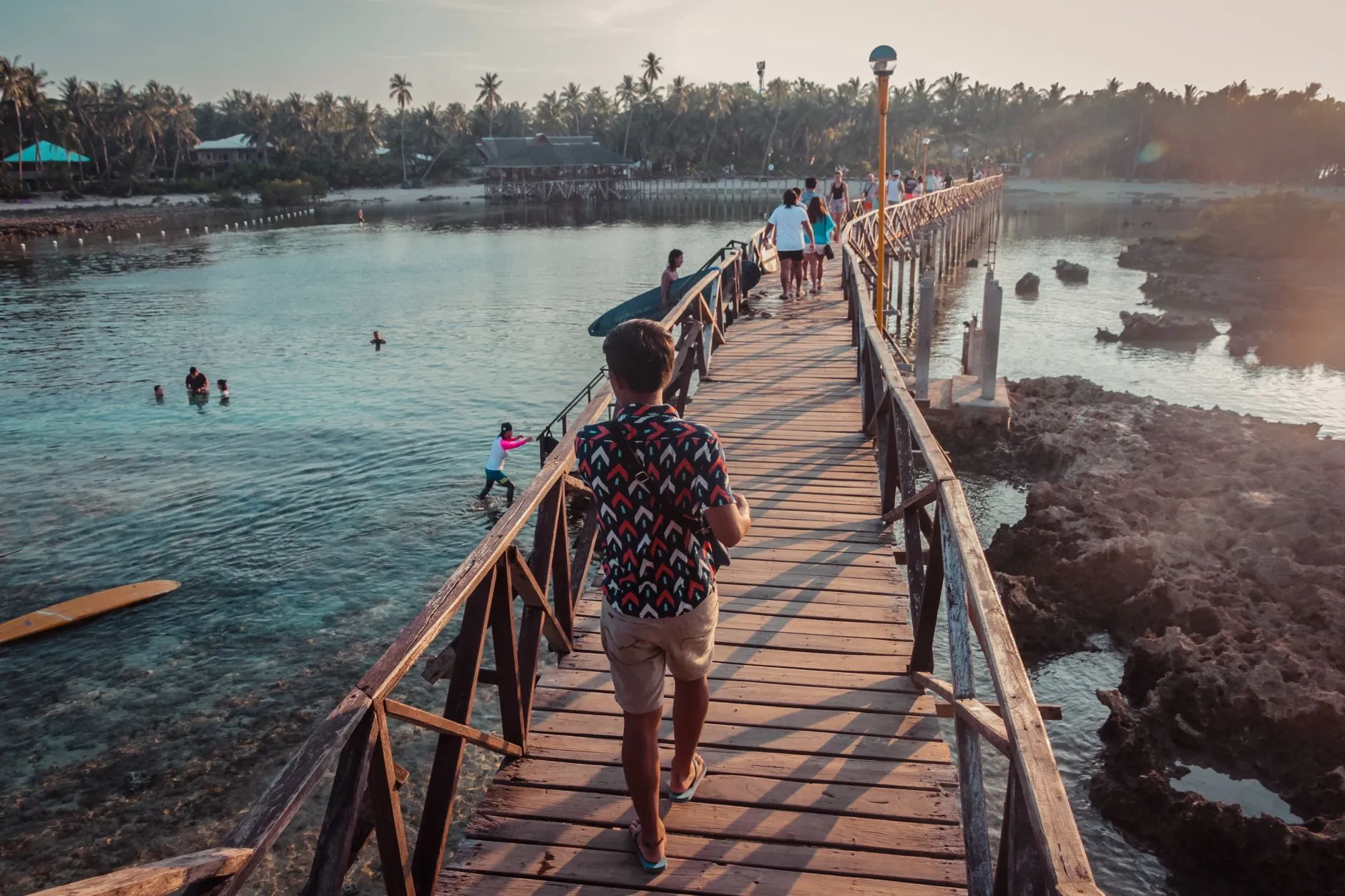
Waves and coastline at Cloud 9

Guides · Siargao

Cloud 9

The wave that built Siargao

Cloud 9 is the wave that built Siargao. It is a thick right breaking at the edge of the reef off General Luna, where the coral shelf drops away into deep Pacific water fed by the Philippine Trench: swell arrives with all its ocean energy intact, jacks up in a couple of board lengths and folds through two quick bowl sections over shallow live coral. Traveling surfers and a run of magazine photos put the wave on the map in the early 1990s, its name borrowed, the story goes, from a Filipino chocolate bar, and within a few years it had a contest, then a tower, then an island growing up around it.

The wooden boardwalk and the judging tower at its end made Cloud 9 the most photographed wave in the Philippines, and the photos are a kind of trap. From the platform it looks like a postcard: turquoise water, a friendly peak, a barrel close enough to touch. Up close it is thick, fast and far heavier than the pictures admit, breaking over coral that sits barely below the surface on the inside. The postcards are honest about the beauty and quiet about the ledge.

Advanced

Wave
Right-hand reef break over shallow coral, two bowl sections
Best swell
E to SE Pacific groundswell and typhoon swell, head-high to well overhead
Best wind
W to SW, calm early mornings
Best tide
Mid to high. Low exposes the ledge
Season
September to November the prize; March to May smaller and cleaner
Level
Advanced. Confident intermediates on small clean mornings

How the wave breaks

There is no slow build at Cloud 9. The reef drops into deep water almost at the takeoff zone, so a swell line that was rolling harmlessly a moment earlier jacks onto the ledge in a couple of seconds and the first bowl throws immediately. The drop and the barrel are effectively one move: you are behind the curtain from the first pump, or you are watching the wave run off without you. On the right day, an east swell with some south in it and a windless morning, that first section spins into a wide, clean tube.

The second bowl follows fast, folding over shallower coral toward the inside. Even a made wave is a short one: Cloud 9 is measured in seconds, not hundreds of meters, and the exit matters as much as the entry. Kick out cleanly before the inside, because the last stretch of reef sits barely underwater at anything below mid tide. There is a left off the same peak, shorter and less celebrated, and a useful option when the right has a queue.
When it works

Cloud 9 faces the open Pacific, and its calendar is written by typhoons. From September to November, storms tracking far to the north send long lines of east swell down Siargao's coast while the local winds go through their lightest stretch of the year: this is the prize window, and the reason the country's main surfing contest has run on this reef in the fall since the mid 1990s. The wind story, honestly simplified: the habagat, the southwest monsoon of roughly June to September, blows offshore here and grooms the wave; the amihan, the northeast monsoon that arrives in December, puts wind on it and makes dawn starts and patience the play until February. From March to May the Pacific goes quiet and Cloud 9 turns small and clean, the season when the wave is far more generous than its reputation.

The lineup and the take-off

You paddle out from the boardwalk, a short channel paddle that puts you in the lineup with dry hair, which is part of why the crowd is what it is. The takeoff zone is tight: one small patch of reef makes the wave, everyone knows exactly where it sits, and on a good day the pack over it runs from local kids who have surfed this ledge since before they could read a forecast to visiting pros here for the photo. They sit deepest and they take the set waves. That is the order of things at Cloud 9, and it is not personal.

The consolation is built into the wave. Rides are short, so nobody disappears down a point for half a kilometer, and the peak resets with every wave: hold your position, wait, and your turn comes around in a way it never does at a long point break. Take the mid-size waves the deep pack lets through, make them cleanly, and the lineup gives you room. Fall on a set wave in front of the tower and the lineup remembers that too.

Getting there

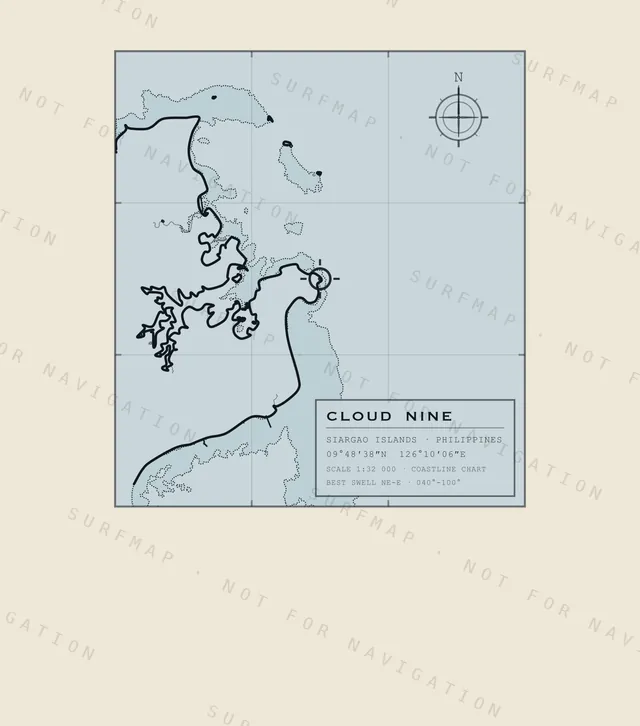
Cloud 9 breaks off the reef at the edge of General Luna, about ten minutes from the town center along the coastal road, by scooter or habal-habal. Park at the entrance, walk the wooden boardwalk out over the reef flat, and use the tower at the end for what it does best: watch a full set from above before you commit to anything. Reaching the island is the longer part of the trip: fly to Sayak airport via Manila or Cebu, then it is about 30 minutes by road to General Luna. In the September to November window, book flights before beds; the island fills up around the contest.

Hazards

  • Sharp, shallow coral, at its shallowest on the inside at lower tides: fall flat and never dive off the front
  • Sea urchins on the reef flat, booties save the walk out and the trip
  • A current sweeps along the reef when the swell is up, check your position against the tower between waves
  • The crowd, from local groms to visiting pros, on every decent day: watch first and wait your turn
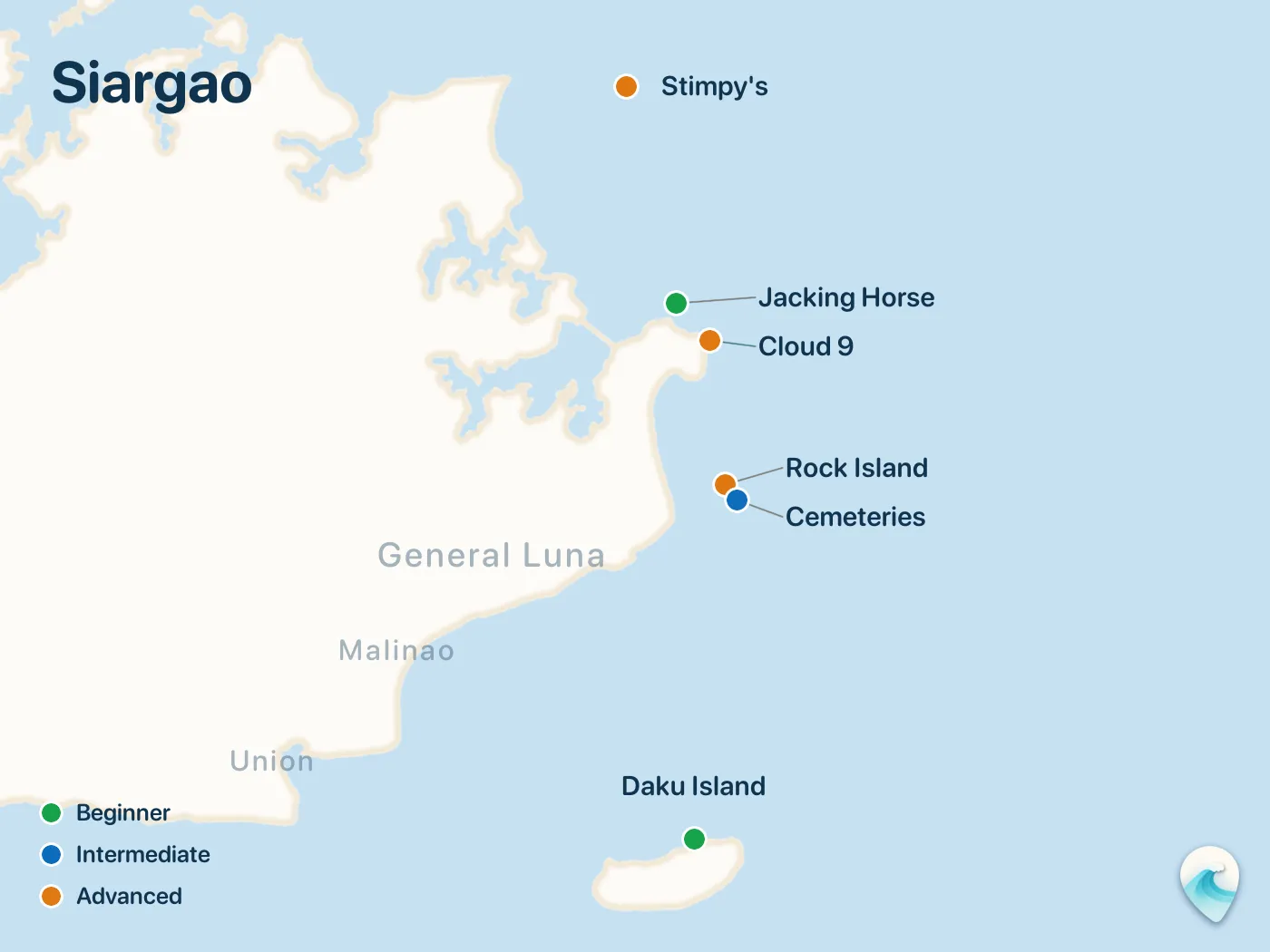
Map of the Siargao surf spots described in this guide, with numbered markers

Part of the Siargao surf guide

An honest guide to surfing Siargao: Cloud 9 and the 6 spots that matter, the boat-trip reefs, where beginners should really start, and the typhoon-swell season month by month.

Read the full guide →

Good to know

Can intermediates surf Cloud 9?

On the right morning, yes. Aim for the small season, March to May, pick a clean chest-high day at mid tide, and spend twenty minutes on the tower first: see where the sets break and who is sitting where. You will get a real taste of the bowl without its full consequence. Two things need to already be true: you know how to fall flat over shallow reef, and you can say no to a wave. When it is overhead and draining on the ledge, the lineup is effectively a contest heat; watch it from the tower, or paddle up the reef to Cemeteries and get eighty percent of the surfing for a fraction of the risk.

What tide is best at Cloud 9?

Mid to high, and most regulars like the mid tide push best: enough water over the coral for the first bowl to throw clean instead of dry, enough pull for the wave to keep its shape. At low the ledge is barely covered, the inside dries in places, and the wave is left to the handful of locals who know exactly which part of it still works. Full high can soften the takeoff a little on smaller swells. If you only remember one rule, make it this one: the bigger the swell or the lower the tide, the fewer people belong out there.

When is Cloud 9 biggest?

September to November, when typhoons passing far north of the Philippines send long-period swell down the island's east coast. This is when the wave holds well overhead, the barrels get properly wide, and the national contest runs on the reef, usually in September. December to February still pulls size from the same ocean, but the amihan wind is on it and the clean days need hunting. If you want Cloud 9 at full scale, book the fall, and accept that the whole surfing Philippines had the same idea.