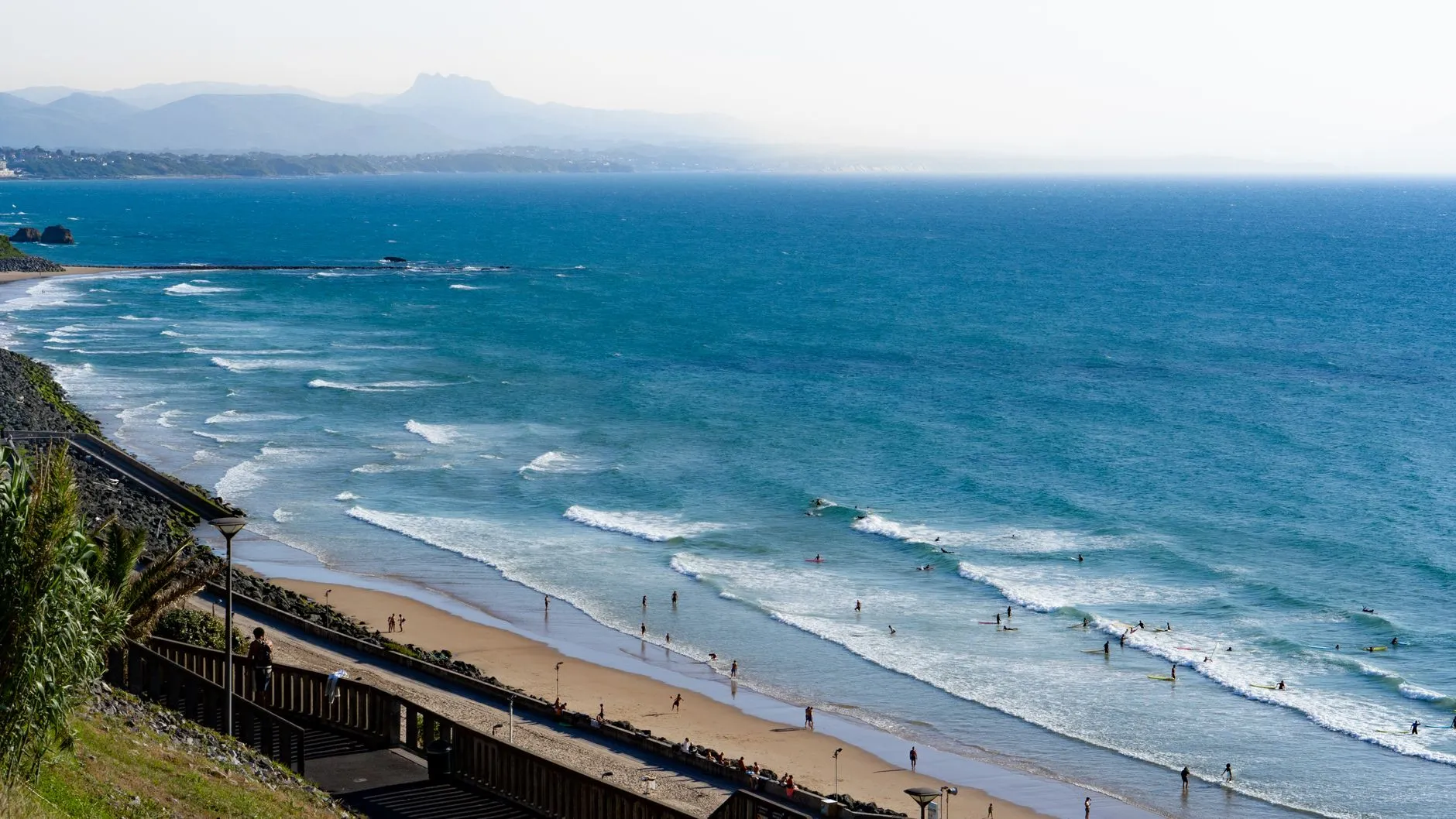
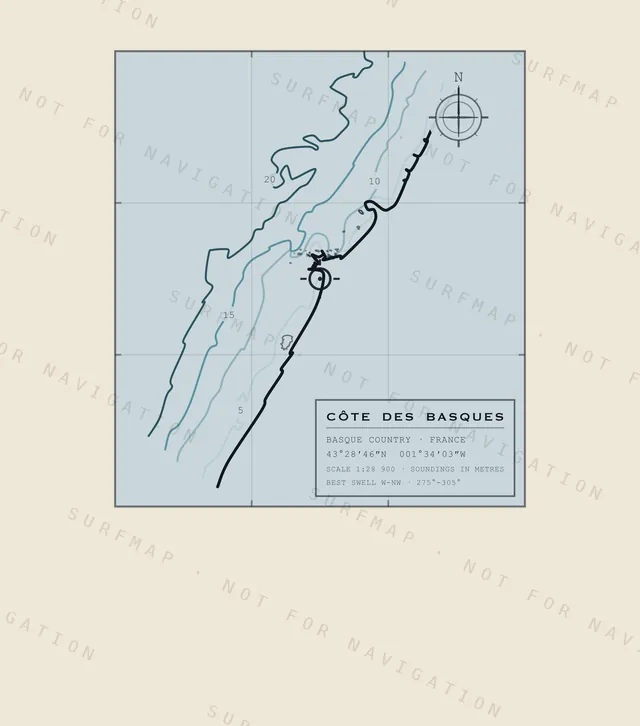
The Côte des Basques is the beach at the southern end of Biarritz, a curve of sand below the cliff promenade with the Villa Belza standing on its rock at the northern end and, on a clear day, the Pyrenees and the Spanish coast lined up on the horizon. Soft, slow walls peel over sand and rock in the shelter of the cliff, and the whole town seems to lean over the railing to watch. It is the most photographed lineup in France, and for good reason: from the water, nowhere else in Europe looks like this.
It is also where surfing in France, and by most accounts in Europe, began. In 1957 the American screenwriter Peter Viertel, in Biarritz for a film shoot, had a board brought over and rode these waves, and the first French surfers followed on this beach. Seventy years later the Côte des Basques is a longboard classic, with a longboard festival every summer, a dozen surf schools along the promenade and a strong claim to being the most beautiful place in Europe to stand up for the first time. One rule comes with it: the beach disappears at high tide, so you surf with the tide, never against it.
Beginner
Wave
Soft sand and rock beach break, long slow walls left and right
Best swell
W to NW, waist-high to double overhead, at its friendliest waist- to chest-high
Best wind
E, the morning land breeze. The cliff takes some of the NW off it
Best tide
Mid tide on the drop. Never at high: the beach disappears
Season
September and October. Mellowest and busiest in summer
Level
Beginner first of all, and longboarders of every level
How the wave breaks
The bottom is sand with rock underneath and around it, and the cliff at your back takes the edge off whatever the open coast is doing. What comes through is a soft, slow wave that stands up gently, peels left and right and keeps rolling for longer than a beach break usually allows. At waist- to chest-high it is a longboard wave first, all glide and trim, and a first wave here tends to carry you a long way toward the sand, which is exactly why the schools line up below the promenade.
Give it a bigger west to northwest swell and the same beach changes character. From head-high upward the walls have real length and push, the peaks toward the Villa Belza take more shape, and in winter this becomes the sheltered corner people drive to when the open Landes beaches to the north are closing out. The headland and the cliff also take some of the northwest wind off the face, so a morning that is blown out in Anglet can still be rideable here. It is never a hollow wave and nobody comes for barrels: they come for the length of the ride and for the view from the lineup.
A surfer on the sand at Biarritz, heading for the water
When it works
Summer is the mellowest season and the busiest. July and August bring warm water, small waves and a lineup full of soft-tops, and the honest advice is to go early, before the schools and before the afternoon sea breeze. September and October are the months the whole Basque coast waits for: the first clean west to northwest groundswells arrive, the water is still around 20°C, the mornings are offshore on the east land breeze, and most of the summer crowd has gone home. Winter, December to March, is cold, around 12 to 14°C, and much bigger; the walls stand up properly and the crowd is mostly local, while the open beaches close out. Spring is uneven, with good windows between fronts.
Whatever the month, the wind follows the same pattern: the east land breeze grooms the face in the morning, and the northwest sea breeze usually fills in by early afternoon and puts texture on it. The cliff softens that sea breeze more than it does at Anglet, but it does not cancel it. Early is better, here as everywhere on this coast.
The lineup and the take-off
The beach sorts itself into zones. In front of the main stairs is the crowd: the surf schools, the longboards and, on every summer morning, a swarm of first take-offs. Toward the Villa Belza and the rocks at the northern end the waves have more shape and the bottom has more rock, so that corner belongs to people who know where everything is. Walk south toward Marbella and Milady and the lineup thins out, at the price of a longer walk back once the tide turns.
The one rule everyone must know is the tide. At high water the sea reaches the wall at the foot of the cliff, the beach is gone and there is no exit along the rocks, so the session is built around mid tide on the drop: in as the water pulls back, surf while the sand widens, out before it comes back to the wall. Low tide uncovers rocks in the lineup and on the way in, especially toward the cliff end and the villa, and a bigger day adds a pull along the rocks. The rest is about what surrounds you: heavy longboards and learners share the same peak, so hold your line, keep hold of your board and give people room.
Getting there and where to stay
You reach the beach down the stairs from the cliff promenade, the Perspective, and the walk is part of the ritual: board under the arm, a long look at the lineup from above, then down. The car parks above the beach fill fast in summer, and the underground car park by the town center is the fallback most people end up using. Biarritz airport is about ten minutes away and the train station about fifteen, which makes this one of the few surf trips in Europe that needs no car at all. Stay in Biarritz itself: the beach is a walk from most of the town, and everything else in this guide, from Anglet to Hendaye, is within about half an hour.
Hazards
The beach disappears completely at high tide and there is no way out along the rocks: check the tide before you paddle out and be on the sand before the water reaches the wall
Rocks in the lineup and on the way in at low tide, especially toward the cliff end and the Villa Belza
Heavy longboards and learners in the same lineup: keep hold of your board, hold your line and give everyone room
A pull along the rocks on bigger days: keep checking where you are drifting and come in early rather than late
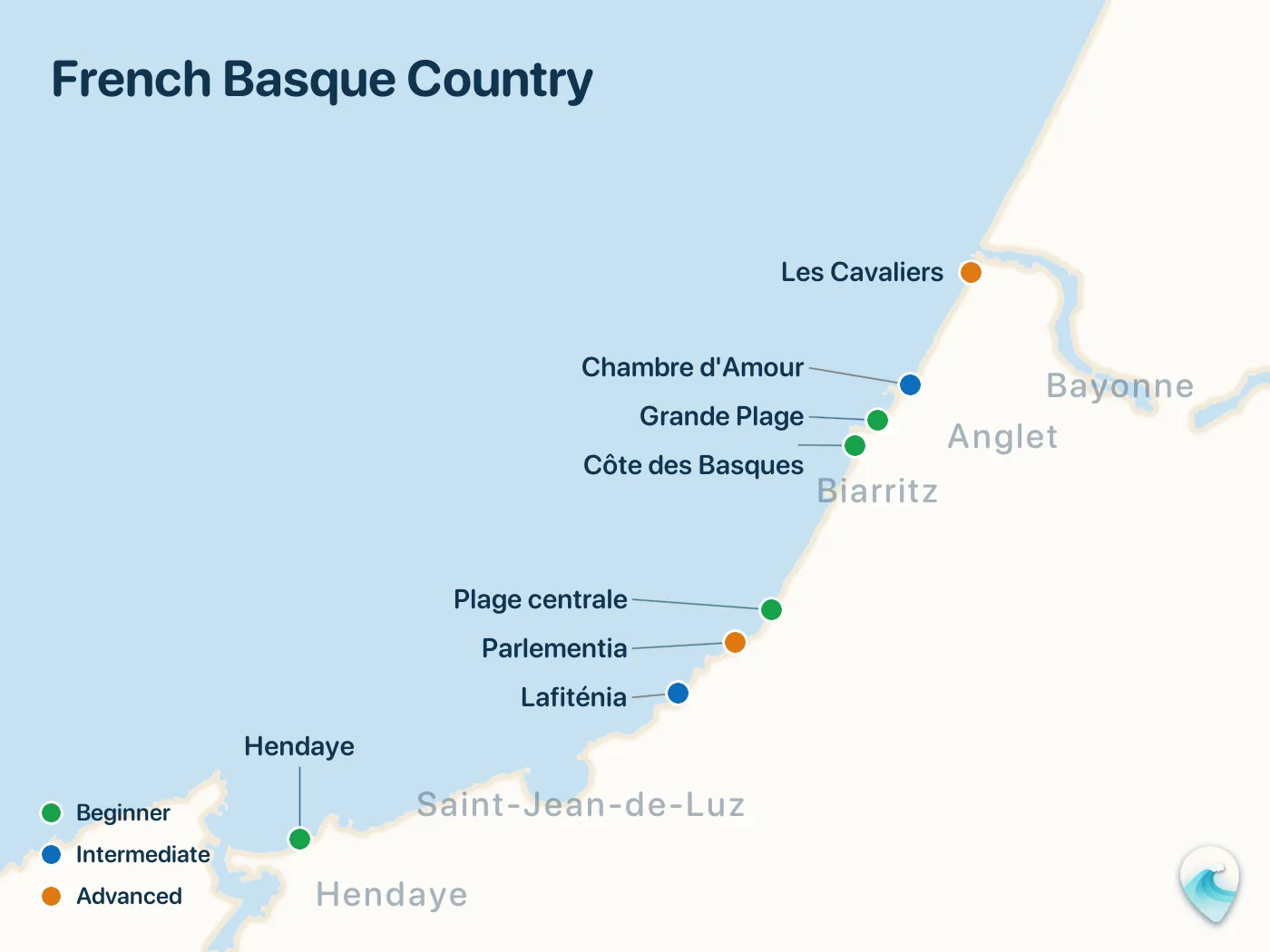
An honest guide to surfing the French Basque Country: the 8 spots that matter from Anglet to Hendaye, who each one suits, when to go month by month, and what to expect in the water.
Yes, it is one of the classic learner beaches of Europe, and probably the most beautiful. The wave is soft and slow, it breaks over sand in the shelter of the cliff, and it rolls long enough for a first ride to feel like a real one. The two honest caveats are the tide, which has to be checked before every session, and the summer crowd, which thins out a lot in September.
Why can you not surf the Côte des Basques at high tide?
Because there is no beach at high tide. The sea comes all the way up to the wall at the foot of the cliff, the sand vanishes, and there is no exit along the rocks toward the villa or to the south. Surfers plan around mid tide on the falling side: in as the water pulls back, out before it returns to the wall. Check the tide times before every session, and give yourself a margin on bigger days.
Why is Biarritz called the birthplace of European surfing?
Because this is where it started, at least on the continent. In 1957 the American screenwriter Peter Viertel was in Biarritz for a film shoot, had a surfboard brought over and rode the waves of the Côte des Basques. A handful of locals watched, tried the board and became the first French surfers, and the first clubs and board makers followed within a few years. The beach still carries that history.